The most important skills everyone should have — and where to learn them.
Equipment is only half the story
Having a well-stocked first aid kit in your hallway cupboard is a great start. But a kit full of bandages, compresses, and antiseptic is only as useful as the person opening it. The difference between someone who freezes during an emergency and someone who acts effectively almost always comes down to one thing: training. Norwegian health authorities are clear on this — everyone who is able to should learn basic first aid, because in many emergency situations, the people already on scene are the ones who make the critical difference.
This isn't about becoming a paramedic. It's about knowing a handful of core skills well enough that you can act quickly and confidently when something goes wrong. The good news is that the most important techniques are straightforward to learn, and a single day of training can give you competence that lasts for years. If you've been putting it off, this is your sign to book a course.
The six skills that matter most
First aid covers a wide range of scenarios, but experts consistently point to six core competencies that everyone should have. These are the skills that make the biggest difference in the situations you're most likely to encounter.
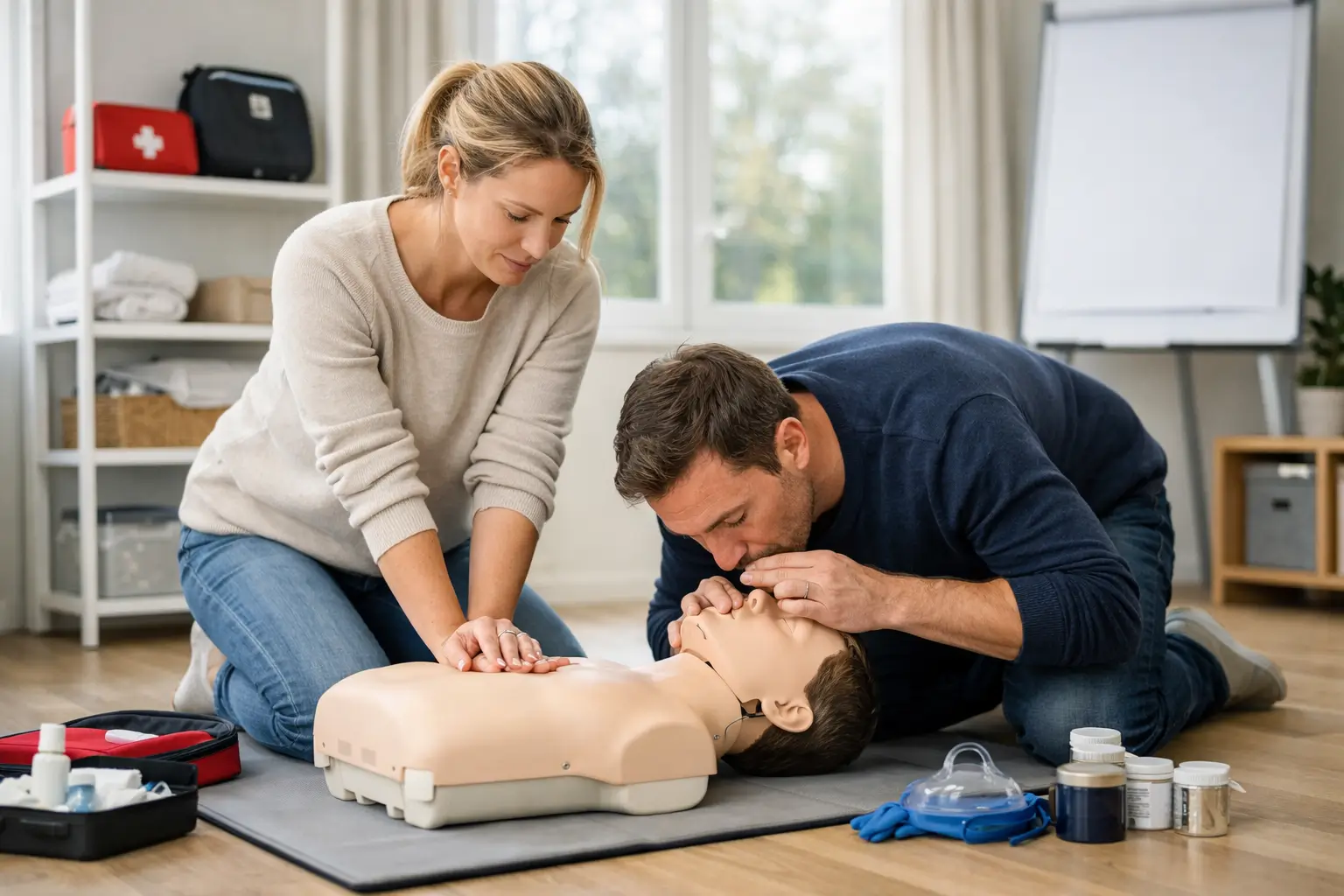
The first is using an automated external defibrillator, or AED. These devices are designed to be used by untrained bystanders — they give spoken instructions and will only deliver a shock if one is needed — but having practiced with one even once makes you far more likely to actually grab it off the wall and use it when someone collapses. The second skill is CPR: chest compressions and rescue breaths. When someone's heart stops, every minute without CPR reduces their chance of survival by roughly ten percent. Bystander CPR before the ambulance arrives is one of the single biggest factors in cardiac arrest survival rates.
The third and fourth skills go hand in hand: assessing whether a person is conscious and assessing whether they're breathing. These checks take only seconds but determine everything that follows — whether you need to start CPR, put someone in the recovery position, or simply monitor them while you wait for help. The fifth skill is controlling external bleeding and keeping an injured person warm, because shock and blood loss are immediate threats that you can meaningfully address with basic materials. The sixth is securing a free airway — tilting the head back and lifting the chin — which is often the only intervention needed to keep an unconscious but breathing person alive.
None of these skills are complicated. All of them can be learned in an afternoon. Together, they cover the vast majority of life-threatening situations a bystander is likely to face.
Why this matters more during a crisis
In everyday life, calling 113 typically gets you professional help within minutes. An ambulance arrives, paramedics take over, and your role as a bystander is relatively brief. During a large-scale crisis — a natural disaster, a major infrastructure failure, a mass casualty event — that equation changes dramatically. Emergency services may be overwhelmed, delayed, or simply unable to reach you. Roads may be blocked. Phone networks may be down or congested.
In those situations, the people in the room, the building, or the neighbourhood become the first responders by default. A household where even one person has basic first aid training is in a fundamentally different position from one where nobody does. You can stabilize an injury, manage a breathing emergency, or keep someone alive until professional help eventually arrives. In a prolonged crisis, that window between injury and professional care could be hours rather than minutes, making your knowledge even more valuable.
This is also why first aid training matters for community resilience, not just individual households. The more people in a neighbourhood who know CPR and wound care, the better that neighbourhood will cope when something goes wrong. It's a skill that benefits everyone around you, not just yourself.
Where to learn
In Norway, the Red Cross (Røde Kors) is the most widely available provider of first aid courses and has equivalents in virtually every country. Their basic course typically runs four to eight hours and covers all the core skills described above, with hands-on practice on mannequins and training defibrillators. It's suitable for anyone from teenagers upward, and no prior experience is needed. Norwegian People's Aid (Norsk Folkehjelp) offers similar courses with a strong practical focus.
Many workplaces are required to have trained first aiders on staff, so it's worth checking whether your employer offers subsidized or free training. Some schools include first aid in their curriculum as well. If you're looking for something more thorough, extended courses of 16 hours or more provide additional practice time and cover a wider range of scenarios, including fractures, burns, poisoning, and allergic reactions.
The cost of a basic course is modest — often comparable to a nice dinner out — and the return on that investment is difficult to overstate. A few hours of your time could genuinely save someone's life one day.
Refreshing your skills
Here's a truth that's easy to forget: first aid skills fade. Studies consistently show that competence in CPR and other techniques declines significantly within one to two years of training if not practiced. The steps start to blur, confidence drops, and the muscle memory that makes you act quickly in an emergency gradually disappears.
The general recommendation is to take a refresher course every two to three years. Refreshers are typically shorter and cheaper than the initial course, and they bring you back up to speed remarkably quickly — the foundation is still there, it just needs dusting off. Some organizations offer half-day refresher sessions specifically designed for people who've taken a full course before.
Between formal refreshers, there are simple things you can do to keep your knowledge sharp. Watch a CPR technique video once or twice a year. Talk through emergency scenarios with your family — what would you do if someone collapsed at the dinner table? Where is the nearest public defibrillator? These small exercises keep the information accessible in your mind and make it far more likely that you'll act rather than freeze when it counts.
Getting children involved
First aid isn't just for adults. Even very young children can learn to be helpful in an emergency, and starting early normalizes the idea that ordinary people — not just doctors and paramedics — have a role to play when someone is hurt.
A child as young as four or five can learn to call the emergency number, tell the operator their name and where they are, and describe what they see. By seven or eight, most children can learn the recovery position and understand the basics of when to call for help. Teenagers are fully capable of taking a real first aid course and performing CPR effectively — in fact, several countries have introduced mandatory first aid training in secondary schools with excellent results.
Making first aid a family activity has benefits beyond the skills themselves. It teaches children that emergencies, while serious, are manageable rather than terrifying. It builds confidence and a sense of responsibility. And practically speaking, it means that if an adult in the household is the one who's injured, there's someone else who knows what to do. Consider taking a course together as a family — many providers offer family-friendly sessions, and learning alongside your children reinforces the material for everyone.
The psychological barrier
Perhaps the biggest obstacle to effective first aid isn't lack of knowledge — it's hesitation. Research on bystander behaviour shows that many people who theoretically know what to do still freeze or hold back in real emergencies. They worry about doing something wrong, about causing harm, about legal liability, or they simply find themselves paralyzed by the shock of the situation.
Training directly addresses this. When you've physically practiced chest compressions on a mannequin, when you've rehearsed the steps of checking consciousness and breathing, when you've held a training defibrillator and heard it talk you through the process, the gap between knowing and doing shrinks enormously. Your hands remember what to do even when your conscious mind is struggling to catch up.
It's also worth internalizing a simple truth that every first aid instructor emphasizes: imperfect CPR is infinitely better than no CPR. Compressions that aren't perfectly positioned or perfectly rhythmic still move blood. A rescue breath that isn't textbook-perfect still delivers oxygen. The only truly wrong response to a cardiac arrest is doing nothing. If your biggest fear is getting it wrong, let that go — getting it roughly right is more than enough to make a real difference.
Self-study resources
Formal courses are the gold standard, but there are good supplementary resources for learning and revision between sessions. The Red Cross offers first aid apps in many countries with step-by-step guides, videos, and quizzes. YouTube has high-quality instructional content from medical professionals and first aid organizations. Books like the Red Cross first aid manual provide thorough reference material you can keep at home.
The one thing self-study cannot replace, however, is hands-on practice. Reading about CPR and actually performing compressions on a mannequin at the correct depth and rate are very different experiences. Videos and apps are excellent for building understanding and refreshing knowledge, but they should lead to a course, not substitute for one. If it's been years since you trained — or if you never have — the single best thing you can do is sign up for a course. It's a few hours that could change everything.
Next step
First aid training pairs naturally with having the right supplies on hand. Use the Min Beredskap app to check whether your household's first aid kit is complete, set reminders for when it's time to refresh your training, and see what other preparedness steps will make the biggest difference for your situation.