A straightforward first-aid kit for home use: what to include, how to maintain it, and common oversights.
What a home first-aid kit is really for
The goal of a home first-aid kit isn't to turn you into a paramedic. It's to handle the common, everyday injuries that happen in any household — cuts, burns, sprains, fevers, allergic reactions — and to buy time for the situations where professional help is needed but hasn't arrived yet. A well-stocked kit and a calm, knowledgeable person can make a genuine difference in those critical minutes.
During an emergency or natural disaster, professional medical help may be delayed or overwhelmed. Roads might be blocked, ambulances stretched thin, clinics without power. In those scenarios, having basic supplies and knowing how to use them moves from "nice to have" to genuinely important. You're not replacing the healthcare system — you're bridging the gap until it can reach you.
The good news is that a solid home first-aid kit is neither expensive nor complicated. Most of what you need is available at any pharmacy, and maintaining it takes about five minutes a few times a year.
What to include: the recommended basics
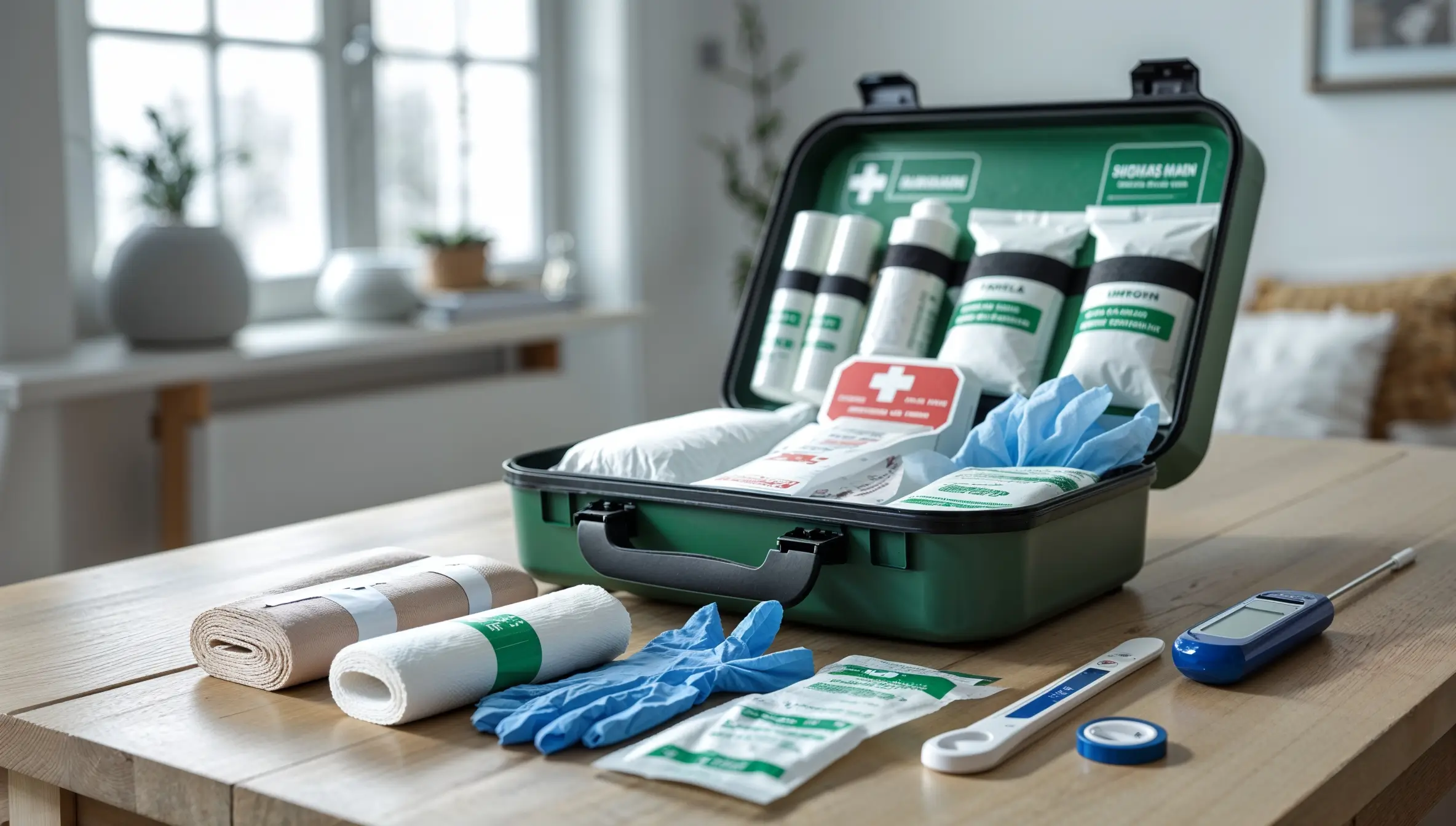
Norwegian health authorities provide clear guidance on what a household first-aid kit should contain. Here's what to stock, organized by purpose:
Pain relief and medication:
- Paracetamol (for pain and fever)
- Antihistamines (for allergic reactions)
- Any prescription medications your household members take regularly
Personal protective equipment:
- Disposable gloves (several pairs)
- Face masks
- Hand sanitizer
- Surface disinfectant
Assessment tools:
- Digital thermometer
- CPR pocket mask (for rescue breathing)
Wound care:
- Assorted adhesive plasters in different sizes
- Sterile bandages with built-in compress
- Sterile gauze compresses
- Wound closure strips
- Wound tape (medical tape)
- Sterile swabs
- Wound wash or antiseptic salve
- Saline solution (for rinsing wounds and eyes)
- Burn gel or burn dressings
Tools:
- Scissors (blunt-tipped medical scissors are ideal)
- Tweezers
- Safety pins
That list might look long, but most of it fits into a single medium-sized box or bag. You can buy pre-assembled kits that cover the basics and then supplement with anything specific to your household — extra paracetamol if you have children (in appropriate dosage), EpiPens if someone has severe allergies, or extra bandaging if your household is particularly active.
Core first-aid skills everyone should know
Supplies without knowledge are only half the equation. There are a handful of skills that dramatically increase your ability to help in a serious situation, and none of them require medical training to learn.
Assessing consciousness and breathing. When someone collapses or is found unresponsive, the first thing to determine is whether they're conscious (do they respond to voice or touch?) and whether they're breathing normally. This assessment takes seconds and determines everything that follows.
CPR (cardiopulmonary resuscitation). If someone isn't breathing, CPR keeps blood flowing to the brain until a defibrillator or ambulance arrives. The technique is straightforward — chest compressions at a steady rhythm, optionally combined with rescue breaths — but it needs to be practiced to be effective under stress.
Using an AED (automated external defibrillator). AEDs are increasingly common in public buildings, shopping centers, and workplaces across Norway. They're designed to be used by untrained bystanders — the device gives spoken instructions and will only deliver a shock if it detects a heart rhythm that requires one. Knowing where your nearest AED is located and having handled one in a course removes hesitation when seconds count.
Stopping bleeding. For minor cuts, clean the wound and apply pressure with a sterile compress. For serious bleeding, firm direct pressure with whatever clean material is available — and keeping that pressure on without peeking — is the single most important intervention. Elevating the injured area above the heart helps reduce blood flow to the wound.
Securing an airway. If someone is unconscious but breathing, placing them in the recovery position (on their side with the airway open) prevents them from choking. It's a simple maneuver that saves lives.
Where to learn: courses and refreshers
Knowing these skills in theory is good. Having practiced them on a mannequin with an instructor watching is much better. Under stress, your hands do what they've been trained to do, not what you've read about.
The Norwegian Red Cross offers first-aid courses throughout the country, ranging from basic half-day introductions to more comprehensive multi-day programs. Many workplaces are required to have trained first-aiders and will pay for employees to attend courses — it's worth asking your employer whether this is available.
If you took a course years ago and feel rusty, a refresher course is valuable. Guidelines for CPR and first aid are updated periodically, and even experienced first-aiders benefit from re-practicing the physical techniques. Muscle memory fades faster than you'd think.
Some municipalities and volunteer organizations also offer free or low-cost first-aid training events, particularly during national preparedness campaigns. Keep an eye on local listings or check with your local Red Cross chapter.
Medication: the often-forgotten essential
First-aid supplies are important, but so is your household's regular medication. If anyone in your home takes prescription medication daily — blood pressure medication, insulin, thyroid hormones, antidepressants, asthma inhalers — having an extra supply on hand is critical. During a disruption, pharmacies may be closed, supply chains interrupted, or roads impassable.
Talk to your doctor about maintaining a buffer stock of essential prescriptions. In Norway, most doctors will write prescriptions for a reasonable surplus if you explain that it's for household preparedness. Even a two-week buffer can make a significant difference.
Check expiry dates on all medications — prescription and over-the-counter — at least twice a year. Expired paracetamol loses potency. Expired EpiPens may not deliver the correct dose. Expired prescription medications can behave unpredictably. Replace anything that's close to its date.
Maintenance: five minutes, four times a year
A first-aid kit only works if it's stocked, current, and findable. The simplest maintenance routine is a quick check every three months — pick a trigger you'll remember, like the start of each season or when the clocks change.
Open the kit, scan the contents, and ask three questions. Is anything missing because it was used? Is anything expired or close to expiring? Does everyone in the household — including older children — know where the kit is kept?
Refill what was used, replace what's expired, and close it up. That's it. Five minutes, four times a year, and your kit is always ready.
Store the kit in a consistent, known, and accessible location. A hallway closet at adult height is a common choice — visible enough that everyone knows where it is, but out of reach of small children. Avoid storing it in the bathroom, where humidity can degrade sterile packaging and medication.
Don't stop at home: car and bag kits
Your home kit is the foundation, but injuries don't only happen at home. A compact first-aid pouch in your car covers roadside incidents, hiking mishaps, and situations where you're helping someone else away from home. A small kit in your everyday bag or backpack — even just a few plasters, a compress, some paracetamol, and a pair of gloves — means you're never completely empty-handed.
Car kits should include a few extras tailored to the environment: a reflective emergency blanket (useful for shock and hypothermia), a larger bandage for more serious wounds, and a notepad and pen for recording details if you witness an accident.
These satellite kits don't need to be elaborate. A ziplock bag with a dozen well-chosen items weighs almost nothing and takes up negligible space. But when you need it, it's worth its weight in gold.
Next step
A first-aid kit is one of those things you hope you'll never need — but when you do, you'll be deeply grateful it's there and stocked. Use the Min Beredskap app to log your first-aid supplies, set maintenance reminders, and see how your household's overall preparedness is shaping up.