Winter, summer and everything in between — a simple checklist for car preparedness.
Your car is more than transport
Most of us think of the car primarily as a way to get from A to B. But in an emergency, a car is a remarkably capable survival tool. It provides shelter from wind and rain. It has a heater that can keep you warm for hours. It has a radio that picks up emergency broadcasts when the internet is down. It has USB ports that can charge your phone and power bank. And it has a trunk that can carry supplies you'd struggle to haul on foot.
Whether you're stranded on a winter road, stuck in traffic during a storm, or using your car as a base during a neighborhood emergency, having the right kit on board transforms the situation from precarious to manageable. The difference between a miserable, potentially dangerous wait and a safe, comfortable one often comes down to a small bag in the trunk that you packed on a calm Sunday afternoon.
None of this requires expensive gear or a survivalist mindset. A thoughtful car kit fits in a single medium-sized bag, costs less than a restaurant dinner, and sits quietly in the trunk until the day you actually need it.
Year-round essentials
Some items belong in your car regardless of the season. These are the things that address the most common roadside situations and legal requirements, and they should live permanently in your trunk.
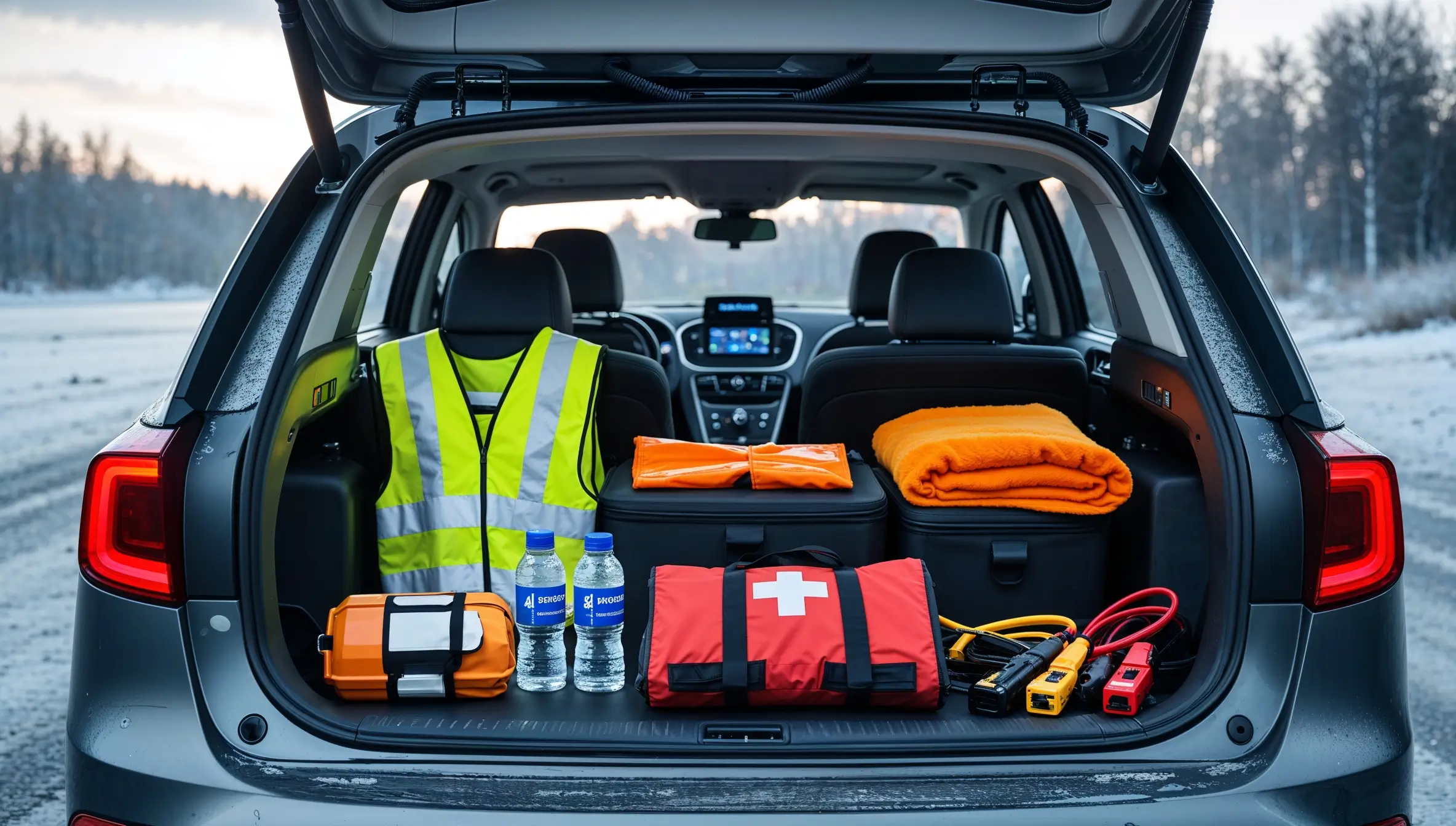
Reflective vests are mandatory to carry in Norway, and you need enough for every occupant — not just the driver. Keep them accessible, not buried under luggage. A warning triangle is equally mandatory and should be easy to reach. A basic first-aid kit covers cuts, scrapes, and minor injuries until you can get proper help. Make sure it includes adhesive bandages, sterile gauze, an elastic wrap, antiseptic wipes, and a pair of disposable gloves.
A flashlight with spare batteries is essential for changing a tire in the dark or signaling for help. A phone charger — the kind that plugs into the 12-volt outlet or USB port — ensures your most important communication tool stays alive. A sturdy blanket provides warmth if the heater fails or if you need to sit by the roadside. One or two liters of drinking water and a few non-perishable snacks (energy bars, nuts, dried fruit) cover the basics if you're stuck for several hours.
Round out the kit with basic tools: a multi-tool or small toolkit, a tow rope, a roll of duct tape, and a pen and paper for exchanging information after a minor collision. Simple, practical, and covering a wide range of situations.
Winter additions: when cold is the real danger
Norwegian winters demand respect, and your car kit should reflect that. Cold is the primary threat when you're stranded in winter — it saps energy, impairs judgment, and can become dangerous far faster than most people realize, especially if the engine won't start or you're low on fuel.
Keep extra warm clothing in the car from October through April: a fleece or down jacket, wool socks, a warm hat, and gloves. These don't need to be your best gear — older items that you'd otherwise donate work perfectly. The point is having dry, warm layers available even if you left the house in a light jacket because the car was warm.
An ice scraper and snow brush are obvious winter necessities, but also consider carrying de-icing fluid for locks and windshield washer fluid rated for severe cold. A small bag of sand or non-clumping cat litter can provide traction if you're stuck on ice — spread it under the drive wheels and you'll often get moving where spinning tires alone would fail. Disposable hand warmers, the kind that activate when you open the package, are cheap, light, and remarkably effective at keeping fingers functional in extreme cold.
One of the most important winter habits is also one of the simplest: keep your fuel tank at least half full. A half-full tank gives you hours of heating if you're stranded, and it prevents fuel-line freezing in extreme cold. It also means you're always ready for an unexpected detour or evacuation. Running the tank down to the warning light is a summer habit that can have real consequences in January.
Summer considerations
Summer driving brings its own set of challenges, particularly on long trips or in remote areas. The risks shift from cold to heat, dehydration, and sun exposure.
Increase your water supply — two liters minimum, more if you're driving with children or in hot weather. Sunscreen and sun hats are wise additions if a breakdown means waiting by the roadside for a tow. Insect repellent makes a roadside wait significantly more bearable in mosquito country during June and July. If you carry chocolate or other heat-sensitive snacks in winter, swap them for something that won't turn into a puddle in a warm trunk.
For those driving to remote cabins or mountain areas in summer, consider carrying a slightly more robust kit: a physical map (phone reception is unreliable in the mountains), extra water, and perhaps a lightweight rain jacket. The weather in Norwegian mountains can shift from sunshine to near-winter conditions in an hour, even in July.
Electric vehicles: a few extra considerations
If you drive an electric vehicle, your preparedness calculus is slightly different. EVs don't have engine-generated heat in the same way, and their range is affected by temperature, terrain, and heating use — sometimes dramatically. A fully charged battery in September might give you 400 kilometers; in January, with the heater running and headlights on, you might get 250.
The practical implications are straightforward. Try to keep your battery above 50 percent as a habit, the same way petrol drivers keep the tank above half. Know the locations of charging stations along your regular routes and any routes you might use in an emergency. Have a backup plan for what to do if you arrive at a charging station and it's out of service or has a long queue — during widespread power outages, charging infrastructure may be down too.
On the positive side, EVs are excellent at providing USB charging and running electronics without engine noise or exhaust fumes. If you're using your car as a temporary shelter, an EV lets you sit inside with the heat on, charge devices, and listen to the radio without worrying about carbon monoxide. That's a genuine advantage over combustion vehicles in certain scenarios.
The car as emergency shelter
There may be situations where your car becomes your temporary home — whether you're stranded on a road, waiting out a storm, or sheltering during an evacuation. Understanding how to use your car effectively in this role makes the experience much safer and more comfortable.
Run the engine periodically rather than continuously. Ten to fifteen minutes every hour keeps the cabin warm and the battery charged without burning through fuel unnecessarily. Always make sure the exhaust pipe is clear of snow or obstructions — carbon monoxide poisoning from a blocked exhaust is a real and fatal risk. If you're parked, crack a window slightly for ventilation, even if it lets in some cold air. The fresh air is worth it.
Use your car's radio to stay informed. Norwegian emergency broadcasts provide instructions and updates during major events, and your car radio will work long after your phone battery has died. If you have a physical map in the glove compartment, it's invaluable for understanding alternative routes when GPS-based navigation is unavailable.
Position your car so that it's visible to passing traffic or rescue services. Turn on hazard lights periodically if battery power allows. If you have a reflective vest, wear it any time you're outside the vehicle. On a dark road in winter, visibility is genuinely life-saving.
Maintenance is preparedness
A reliable car is a prepared car. The most comprehensive emergency kit in the world doesn't help much if the car itself won't start or breaks down on the first kilometer. Regular servicing, good-quality tires appropriate for the season, and addressing small mechanical issues before they become large ones are all forms of preparedness.
Check tire pressure and tread depth regularly. Make sure all lights are working. Keep windshield washer fluid topped up. Replace wiper blades before they start smearing. These are small maintenance tasks, but together they ensure that your car is ready to perform when you need it — not just as transport, but as the mobile shelter, charging station, and communication hub it can be during an emergency.
Storage and rotation
Your car kit should live in a single bag or small box in the trunk, organized so you can find things quickly in the dark. A medium-sized duffel bag or a plastic storage box with a lid both work well. Avoid scattering items loose across the trunk — you'll never find the flashlight when you need it.
Rotate seasonal items twice a year, at roughly the same time you switch between summer and winter tires. In October, add the warm clothing, hand warmers, de-icing fluid, and traction aids. In April, swap those out for extra water, sunscreen, and insect repellent. Check expiration dates on snacks, inspect batteries, and test the flashlight during each rotation.
The beauty of a car kit is that once it's packed, it requires almost no thought until the next rotation. It just sits there, taking up a small corner of the trunk, until the day you reach for it and realize it was one of the best small investments you ever made.
Next step
Check what's in your car right now — you might be pleasantly surprised, or you might find a few gaps. Log your car kit in the Min Beredskap app alongside your household supplies for a complete picture of your preparedness. A few items in the trunk can make all the difference when the unexpected happens on the road.